 Essential Nose
Bergamot
Genus Citrus
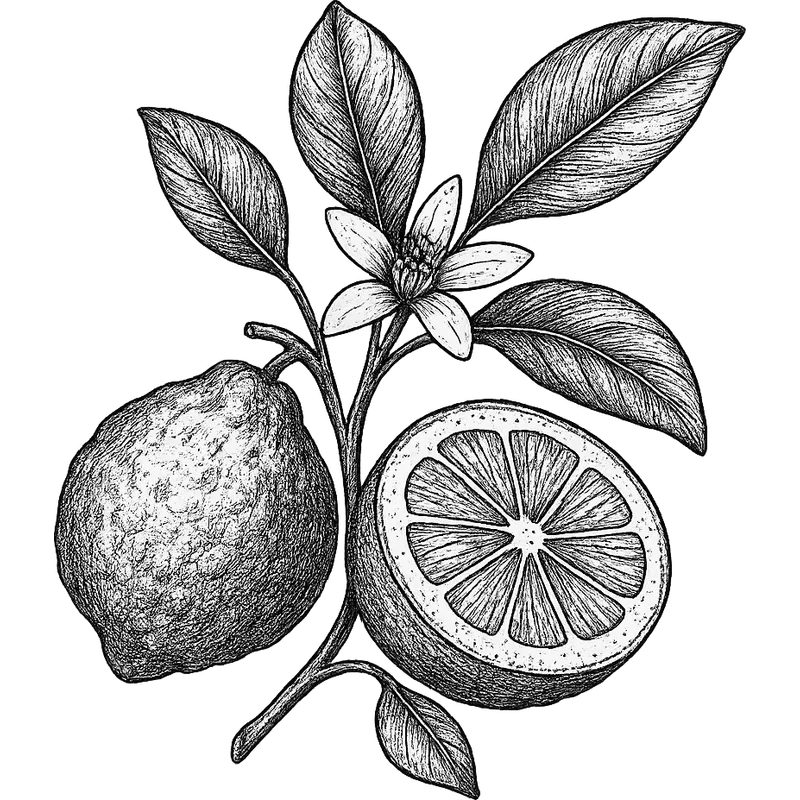
Bergamot is the citrus that smells like a flower, and it is the scent in Earl Grey tea. About half the oil is limonene, the plain orange-peel note. The rest is largely linalyl acetate, the compound lavender uses to smell soft, and that is where the floral side comes from. In a controlled study, smelling it lifted people's mood, shifted them into a calmer nervous state and lowered the stress hormone in their saliva.[3] Reviews rate it among the best-evidenced oils for mood.[1]
Bergamot
Citrus bergamia
- Also Known As
- Bergamot Orange
- Family
- Citrus
- Perfumery Note
- Top
- Intensity
- Medium
- Extraction
- Cold Pressed
- Plant Parts
- Fruit peel
- Origins
- Italy, Morocco, Ivory Coast
- Effect
- Sleep & Relaxation, Energy & Uplifting
- Aroma
- Citrus, Sweet, Floral, Slightly Spicy
- Applications
- Diffusing & Inhalation, Skincare, Perfumery & Fragrance Making
- Price
- $$$$Requires an extra distillation step to remove bergapten, the chemical that causes sun sensitivity
This is the standard cold-pressed bergamot, squeezed from the peel of a sour citrus fruit. Limonene gives it the citrus, linalyl acetate gives it the flower, and together they make the smell of Earl Grey. It also carries bergapten, which reacts with sunlight and burns skin, so do not wear it on a sunny day.[3] In a controlled study of 41 women, breathing it in improved mood, calmed the nervous system and lowered the stress hormone in saliva.[1]
Bergamot FCF
Citrus bergamia
- Also Known As
- Bergamot BF (Bergapten-Free), Furocoumarin-Free Bergamot, Rectified Bergamot
- Family
- Citrus
- Perfumery Note
- Top
- Intensity
- Medium
- Extraction
- Cold Pressed
- Plant Parts
- Fruit peel
- Origins
- Italy, Morocco, Ivory Coast
- Effect
- Sleep & Relaxation, Energy & Uplifting
- Aroma
- Citrus, Sweet, Floral, Slightly Spicy
- Applications
- Diffusing & Inhalation, Skincare, Perfumery & Fragrance Making
- Price
- $$$$Furocoumarin-free bergamot requires an additional molecular distillation step to remove bergapten; the extra processing adds cost over standard bergamot, though it remains in the moderate price range
FCF stands for furocoumarin-free, and it is ordinary bergamot with the sunburn problem taken out. A second distillation under vacuum strips out the bergapten while leaving the limonene and linalyl acetate behind, so it smells almost exactly the same. Lab work and human patch tests confirmed that the burning is caused by that one group of compounds, and stops once they are gone.[4] That makes FCF the grade to use in anything left on skin, or in massage oil, when you cannot control who goes outside afterwards. Reports of blistering burns from ordinary bergamot are what prompted it.[5]
References
- [1]Effects of bergamot (Citrus bergamia) essential oil aromatherapy on mood states, parasympathetic nervous system activity, and salivary cortisol levels in 41 healthy females - Watanabe E et al. Forschende Komplementarmedizin, 2015
- [2]Citrus bergamia essential oil: from basic research to clinical application - Navarra M et al. Frontiers in Pharmacology, 2015
- [3]Action spectrum for bergamot-oil phototoxicity measured by sunburn cell counting - Yasui Y, Hirone T. Journal of Dermatology, 1994
- [4]Phototoxicity of bergamot oil assessed by in vitro techniques in combination with human patch tests - Kejlova K et al. Toxicology in Vitro, 2007
- [5]Accidental bullous phototoxic reactions to bergamot aromatherapy oil - Kaddu S, Kerl H, Wolf P. Journal of the American Academy of Dermatology, 2001