 Essential Nose
Cardamom
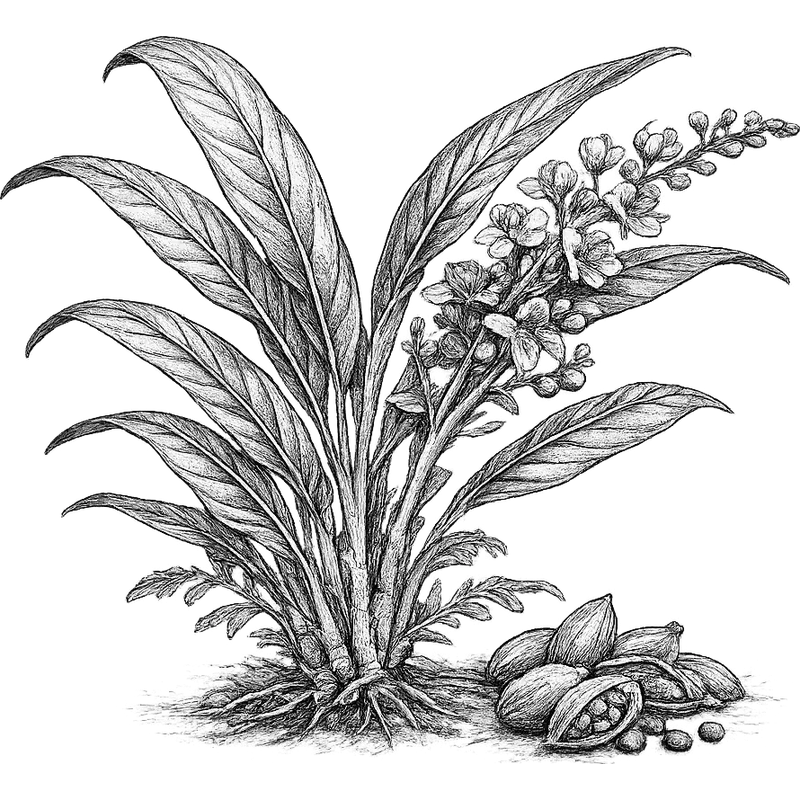
Two different plants are sold as cardamom, and they smell nothing alike. Green cardamom is the sweet, eucalyptus-bright one used in baking and chai. Black cardamom is smoke-cured over wood fires and comes out tarry and savoury. Green cardamom runs on alpha-terpinyl acetate and 1,8-cineole, and in lab tests held back E. coli and Pseudomonas.[1] In rats it protected the stomach lining against induced ulcers, which fits its old use as a digestive.[2]
Green Cardamom
Elettaria cardamomum
- Also Known As
- Cardamom, True Cardamom
- Family
- Spice
- Perfumery Note
- Middle
- Intensity
- Medium
- Extraction
- Steam Distillation
- Plant Parts
- Seeds
- Origins
- Guatemala, India, Sri Lanka
- Effect
- Energy & Uplifting, Focus & Mental Clarity
- Aroma
- Spicy, Sweet, Balsamic
- Applications
- Diffusing & Inhalation, Massage & Body, Perfumery & Fragrance Making, Cooking & Flavouring
- Price
- $$$$One of the world's most expensive spices; the oil yield is small and the pods are hand-picked
Green cardamom oil is distilled from the seeds inside the pod. About a third is alpha-terpinyl acetate, which gives the sweetness, and a quarter is 1,8-cineole, which gives the eucalyptus lift. That combination is why cardamom smells both sweet and cooling at once. In lab tests it held back E. coli and Pseudomonas aeruginosa, two gut and wound bacteria, at low concentrations.[1] In rats it protected the stomach lining against induced ulcers.[2]
Black Cardamom
Amomum subulatum
- Also Known As
- Large Cardamom, Greater Cardamom, Nepal Cardamom, Brown Cardamom
- Family
- Spice
- Perfumery Note
- Middle
- Intensity
- Strong
- Extraction
- Steam Distillation
- Plant Parts
- Seeds
- Origins
- Nepal, India, Bhutan
- Effect
- Respiratory Support, Grounding & Centering
- Aroma
- Smoky, Camphoraceous, Woody, Spicy
- Applications
- Diffusing & Inhalation, Perfumery & Fragrance Making, Cooking & Flavouring
- Price
- $$$$Large cardamom pods are more abundant and less labor-intensive to harvest than true green cardamom, keeping oil costs comparatively moderate despite the extra fire-curing step.
Black cardamom is a different genus, and the pods are dried over open wood fires. That smoking is what gives the oil its tarry, campfire character, quite unlike green cardamom's sweetness. Chemically it swaps the sweet ester for 1,8-cineole, which makes up nearly half the oil.[3] In lab tests it held back Pseudomonas, E. coli and Acinetobacter baumannii, a hospital bacterium that resists most drugs.[3] Applied to skin it calmed inflammation in animal testing, which fits its Ayurvedic use for chest and gut complaints.[4]
References
- [1]Effects of Essential Oils of Elettaria cardamomum Grown in India and Guatemala on Gram-Negative Bacteria and Gastrointestinal Disorders - Shanmugam S et al. Antibiotics, 2021
- [2]Gastroprotective effect of cardamom, Elettaria cardamomum Maton. fruits in rats - Al-Zuhair H et al. J Ethnopharmacol, 2005
- [3]Composition and pharmacological activity of essential oils from two imported Amomum subulatum fruit samples - Alam A, Singh V. J Taibah Univ Sci, 2020
- [4]Chemical composition, antimicrobial and topical anti-inflammatory activity of essential oil of Amomum subulatum fruits - Agnihotri SA, Wakode SR, Ali M. Acta Pol Pharm, 2012