 Essential Nose
Cinnamon
Genus Cinnamomum
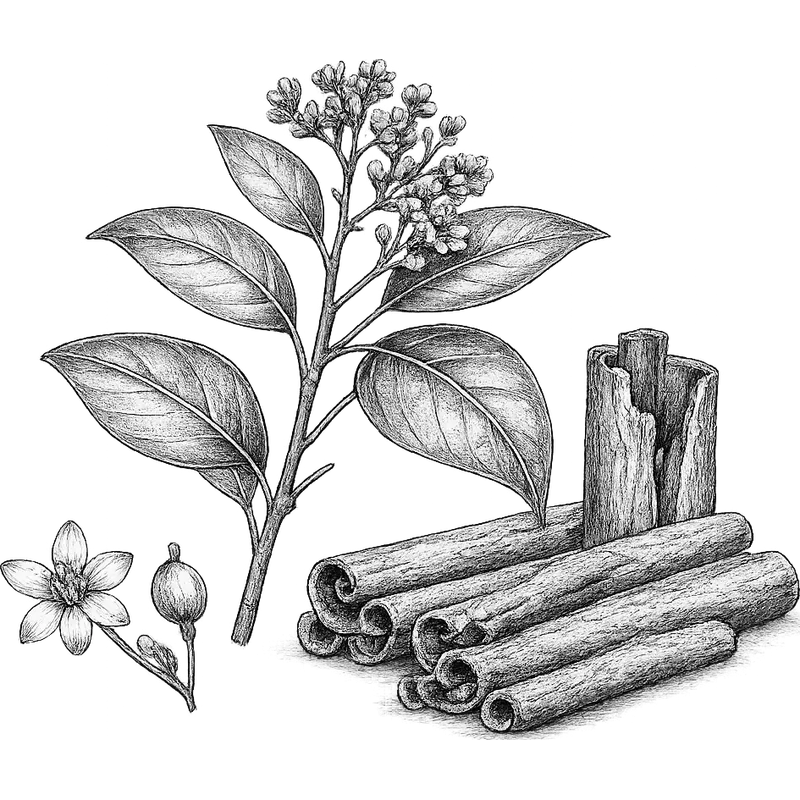
One tree gives two completely different oils, and a second species gives a third. Bark oil is mostly cinnamaldehyde and smells like cinnamon should, sweet and warm. Leaf oil from the same tree is mostly eugenol and smells of cloves instead. Cassia is a different species, also cinnamaldehyde, but harsher and cheaper, and it is what most food flavouring uses. All three are among the strongest antibacterial oils in lab tests, and all three burn and sensitise skin, so they need heavy dilution.[1][2]
Cinnamon Bark
Cinnamomum verum
- Also Known As
- Ceylon Cinnamon Bark, True Cinnamon Bark, Sri Lanka Cinnamon, Cinnamomum zeylanicum
- Family
- Spice
- Perfumery Note
- Middle
- Intensity
- Very Strong
- Extraction
- Steam Distillation
- Plant Parts
- Bark
- Origins
- Sri Lanka, Madagascar, India
- Effect
- Romance & Mood, Energy & Uplifting, Respiratory Support
- Aroma
- Spicy, Sweet, Warm, Rich
- Applications
- Diffusing & Inhalation, Cooking & Flavouring, Household & Cleaning
- Price
- $$$$Harvesting true cinnamon bark from Cinnamomum verum requires skilled hand-peeling of thin inner bark in Sri Lanka and Madagascar; the labour-intensive process and lower oil yield make bark oil significantly more expensive than leaf oil
Cinnamon bark oil is the real thing, two thirds to four fifths cinnamaldehyde. That is what makes it smell sweet and rounded where cassia smells flat and hot. In lab tests it tore open bacterial cell walls and spilled their contents, including in strains of E. coli that resist several drugs.[3] It also mops up the unstable molecules that damage cells.[4] Cinnamaldehyde is a known skin sensitiser, so keep it under half a percent in anything left on skin, and patch test first.[5]
Cinnamon Leaf
Cinnamomum verum
- Also Known As
- Ceylon Cinnamon Leaf, True Cinnamon Leaf, Cinnamomum zeylanicum
- Family
- Spice
- Perfumery Note
- Middle
- Intensity
- Strong
- Extraction
- Steam Distillation
- Plant Parts
- Leaves
- Origins
- Sri Lanka, India, Madagascar
- Effect
- Sleep & Relaxation, Respiratory Support
- Aroma
- Spicy, Clove-like, Warm, Less Sweet than Bark
- Applications
- Diffusing & Inhalation, Cooking & Flavouring, Household & Cleaning
- Price
- $$$$Leaves are easily steam-distilled alongside pruning waste from cinnamon trees; the high leaf yield and minimal processing effort make leaf oil much cheaper than bark oil from the same tree
Cinnamon leaf oil comes from the same tree as bark oil but smells of cloves, not cinnamon. The reason is eugenol, which makes up most of it, where the bark runs on cinnamaldehyde. It is gentler on skin than bark oil, though it still sensitises and still needs diluting.[5] In lab tests it broke up the protective films that Pseudomonas, Staphylococcus and Klebsiella build on surfaces.[6] It did the same to Candida films, at strengths you could actually use in a skin preparation.[7]
Cassia
Cinnamomum cassia
- Also Known As
- Chinese Cinnamon, Bastard Cinnamon, Cassia Cinnamon, Cinnamomum aromaticum
- Family
- Spice
- Perfumery Note
- Middle
- Intensity
- Very Strong
- Extraction
- Steam Distillation
- Plant Parts
- Bark
- Origins
- China, Vietnam, Indonesia
- Effect
- Romance & Mood, Energy & Uplifting, Respiratory Support
- Aroma
- Spicy, Warm, Harsh, Less Complex than Ceylon
- Applications
- Diffusing & Inhalation, Cooking & Flavouring, Household & Cleaning
- Price
- $$$$Often called "Chinese Cinnamon," it is cheaper and more abundant than true cinnamon
Cassia is what most of the world actually tastes when it tastes cinnamon. It is even higher in cinnamaldehyde than true cinnamon but lacks the sweet esters, so it lands hot and flat. In lab tests it held back bacteria, yeasts and moulds at very low concentrations.[2] Paired with an antibiotic it worked against Klebsiella strains that shrug off almost everything.[8] Like all cinnamon oils it sensitises skin and needs heavy dilution.[5]
References
- [1]Antibacterial and Antibiofilm Activities of Cinnamomum Sp. Essential Oil and Cinnamaldehyde: Antimicrobial Activities - Firmino DF, Cavalcante TTA, Gomes GA, Firmino NCS, Rosa LD, de Carvalho MG, Catunda Jr FEA. ScientificWorldJournal, 2018
- [2]Antimicrobial activities of cinnamon oil and cinnamaldehyde from the Chinese medicinal herb Cinnamomum cassia Blume - Ooi LSM, Li Y, Kam SL, Wang H, Wong EYL, Ooi VEC. American Journal of Chinese Medicine, 2006
- [3]Antibacterial Mode of Action of Cinnamomum verum Bark Essential Oil, Alone and in Combination with Piperacillin, Against a Multi-Drug-Resistant Escherichia coli Strain - Yap PSX, Krishnan T, Chan KG, Lim SHE. Journal of Microbiology and Biotechnology, 2015
- [4]Chemical Composition and Antioxidant, Antimicrobial, and Antiproliferative Activities of Cinnamomum zeylanicum Bark Essential Oil - Alizadeh Behbahani B, Falah F, Lavi Arab F, Vasiee M, Tabatabaee Yazdi F. Evidence-Based Complementary and Alternative Medicine, 2020
- [5]Allergic contact dermatitis from essential oil in consumer products: mode of uses and value of patch tests with an essential oil series - Barbaud A et al. Contact Dermatitis, 2023
- [6]In-vitro Antibacterial and Antibiofilm Activity of Cinnamomum verum Leaf Oil against Pseudomonas aeruginosa, Staphylococcus aureus and Klebsiella pneumoniae - Wijesinghe GK, Feiria SB, Maia FC, Oliveira TR, Joia F, Barbosa JP, Boni GC, Hofling JF. Anais da Academia Brasileira de Ciencias, 2021
- [7]Efficacy of true cinnamon (Cinnamomum verum) leaf essential oil as a therapeutic alternative for Candida biofilm infections - Wijesinghe GK, de Oliveira TR, Maia FC, Feiria SB, Barbosa JP, Joia F, Boni GC, Hofling JF. Iranian Journal of Basic Medical Sciences, 2021
- [8]Synergistic effects of Cinnamomum cassia L. essential oil in combination with polymyxin B against carbapenemase-producing Klebsiella pneumoniae and Serratia marcescens - Vasconcelos NG, Queiroz JHF de S, da Silva KE, Vasconcelos PC de P, Croda J, Simionatto S. PLoS One, 2020