 Essential Nose
Cypress
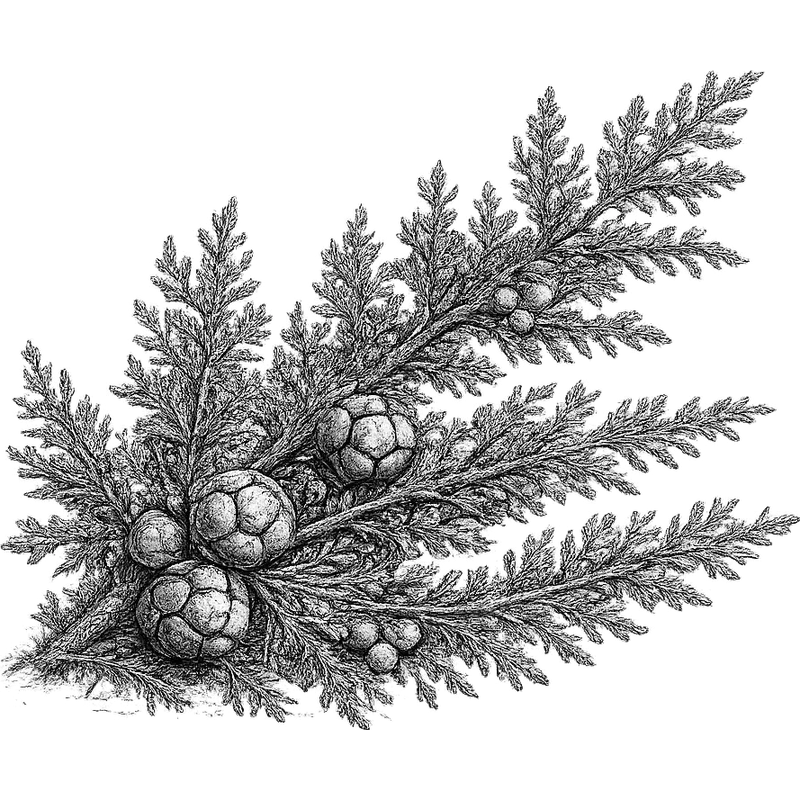
Cypress oil comes from the twigs and needles, which is why it smells green and resinous. Mediterranean cypress is the standard, about half alpha-pinene, dry and evergreen. Blue cypress is a different tree from northern Australia, distilled from the wood, and its oil is literally blue. In lab tests Mediterranean cypress oil completely stopped Helicobacter pylori growing at a tenth of a percent, including drug-resistant strains.[1] It also held back fungi, mopped up unstable molecules and killed insects in testing.[2]
Mediterranean Cypress
Cupressus sempervirens
- Also Known As
- Cypress, Italian Cypress
- Family
- Woody
- Perfumery Note
- Middle
- Intensity
- Medium
- Extraction
- Steam Distillation
- Plant Parts
- Wood
- Origins
- France, Spain, Morocco
- Effect
- Grounding & Centering, Respiratory Support
- Aroma
- Woody, Fresh, Evergreen
- Applications
- Diffusing & Inhalation, Skincare, Massage & Body
- Price
- $$$$Widely grown across France, Spain, and Morocco; the wood and foliage are abundant and steam distillation is straightforward, keeping this the more accessible of the two cypress oils.
This is the tall dark cypress of Italian roadsides and Tuscan hillsides. Its oil smells dry, green and resinous, more austere than pine. About half is alpha-pinene, with delta-3-carene at a fifth adding the sharpness. In lab tests a tenth of a percent completely stopped Helicobacter pylori growing, the stomach bacterium behind ulcers, including strains that resist antibiotics.[1] Further testing confirmed it holds back bacteria and fungi and acts as an insecticide.[2]
Blue Cypress
Callitris intratropica
- Also Known As
- Australian Blue Cypress, Northern Cypress Pine, Blue Cypress Pine
- Family
- Woody
- Perfumery Note
- Base
- Intensity
- Medium
- Extraction
- Steam Distillation
- Plant Parts
- Wood, Bark
- Origins
- Australia
- Effect
- Grounding & Centering, Sleep & Relaxation
- Aroma
- Woody, Balsamic, Warm, Sweet
- Applications
- Diffusing & Inhalation, Skincare, Perfumery & Fragrance Making
- Price
- $$$$Harvested only from wild and plantation-grown trees in Australia's Northern Territory; the dense heartwood requires prolonged distillation, and the rich cobalt-blue guaiazulene content makes it substantially costlier than common cypress oils.
Blue cypress oil really is blue, a deep cobalt that comes out of the still. The colour is made during distillation, when compounds in the wood turn into azulenes, the same family that turns German chamomile blue. It smells warm and balsamic rather than fresh, nothing like Mediterranean cypress. Testing found moderate cell protection and calming of inflammation, in line with Aboriginal use in Arnhem Land on skin and wounds.[3] As a mosquito repellent it worked at first but faded much faster than DEET within an hour.[4]
References
- [1]Chemical composition, antimicrobial and antibiofilm activity of the essential oil and methanol extract of the Mediterranean cypress (Cupressus sempervirens L.) - Selim SA et al. Ann Clin Microbiol Antimicrob, 2014
- [2]Antioxidant, antibacterial and insecticidal activities of cypress (Cupressus sempervirens L.) essential oil - Ben Farhat M et al. Molecules, 2023
- [3]Antioxidant and anti-inflammation activities of Ocotea, Copaiba and blue cypress essential oils in vitro and in vivo - Amilia Destryana R, Young DG, Woolley CL, et al. Journal of the American Oil Chemists' Society, 2014
- [4]Mosquito Repellent Efficacy of Australian Blue Cypress Callitris intratropica Essential Oil and a Topical Formulation under Laboratory and Field Conditions - Koinari M et al. Am J Trop Med Hyg, 2023