 Essential Nose
Frankincense
Genus Boswellia
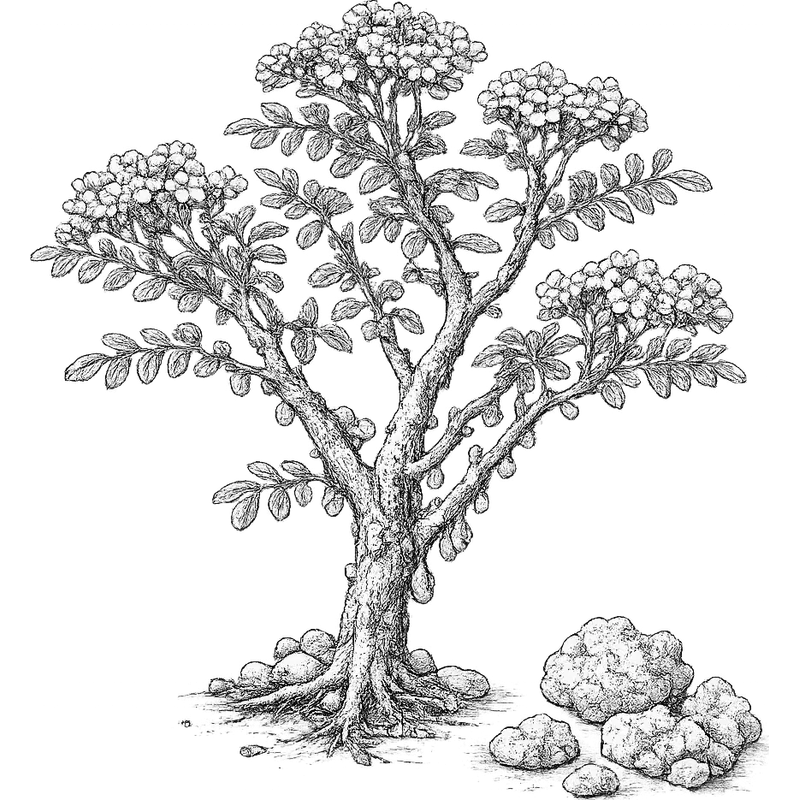
Frankincense oil is steam-distilled from tree resin, smells resinous and warm, and carries incensole acetate, a compound found in no other plant. In animal studies that compound eased anxiety and low mood by switching on a channel in the brain that also responds to warmth.[1] How much of it an oil holds varies by species, which is part of why Somali and Indian frankincense smell different.[2] One thing the oil does not carry is boswellic acids. Those swelling-calming compounds frankincense is famous for are too heavy to survive distillation, and stay behind in the resin.
Frankincense Carterii
Boswellia carterii
- Also Known As
- Olibanum, East African Frankincense, Somali Frankincense
- Family
- Resinous
- Perfumery Note
- Base
- Intensity
- Medium
- Extraction
- Steam Distillation
- Plant Parts
- Resin
- Origins
- Somalia, Oman, Ethiopia
- Effect
- Sleep & Relaxation, Grounding & Centering
- Aroma
- Woody, Balsamic, Earthy
- Applications
- Diffusing & Inhalation, Skincare, Massage & Body, Perfumery & Fragrance Making
- Price
- $$$$Wild-tapped from Boswellia carterii trees across Somalia and Ethiopia; the most widely traded frankincense species, keeping price moderate despite the entirely manual resin harvest
Carterii is the frankincense you are most likely to be sold, tapped in Somalia and Ethiopia. It smells warm and balsamic with a bright citrus lift on top. It is also the least consistent: analysis has found at least three different forms of it, depending on where and when the resin was tapped.[3] One is heavy in a-pinene, one in a-thujene, one in a compound called methoxydecane.[3] All of them keep a little incensole acetate, the compound behind the calming effect seen across the genus in animal studies.[1]
Frankincense Sacra
Boswellia sacra
- Also Known As
- Hougary Frankincense, Omani Frankincense, Sacred Frankincense, Royal Frankincense
- Family
- Resinous
- Perfumery Note
- Base
- Intensity
- Medium
- Extraction
- Steam Distillation
- Plant Parts
- Resin
- Origins
- Oman, Yemen, Somalia
- Effect
- Grounding & Centering
- Aroma
- Balsamic, Citrusy, Clean, Slightly Sweet
- Applications
- Diffusing & Inhalation, Skincare, Massage & Body, Perfumery & Fragrance Making
- Price
- $$$$Boswellia sacra from Oman is considered the premium grade; controlled regional exports and strong demand from luxury and religious markets push the price above other frankincense species
Omani luban is the frankincense of the incense trade, cleaner and more citrus-forward than the East African oils. That comes from a-pinene, which is the main compound in all four commercial grades.[4] Botanists still argue about whether it is really a separate species from carterii, and some treat the two as one. Testing those four grades found the oil held back a range of bacteria.[4] In human cell culture the oil damped how strongly immune cells activated one another, a dish finding rather than an effect in people.[5]
Frankincense Serrata
Boswellia serrata
- Also Known As
- Indian Frankincense, Salai Guggul, Indian Olibanum, Shallaki
- Family
- Resinous
- Perfumery Note
- Base
- Intensity
- Medium
- Extraction
- Steam Distillation
- Plant Parts
- Resin
- Origins
- India, Pakistan
- Effect
- Grounding & Centering, Sleep & Relaxation
- Aroma
- Warm, Spicy, Balsamic, Slightly Peppery, Earthy
- Applications
- Diffusing & Inhalation, Skincare, Massage & Body, Perfumery & Fragrance Making
- Price
- $$$$Indian olibanum from widely cultivated Boswellia serrata trees; broader plantation access and larger production volumes make it the most affordable frankincense species
Indian frankincense is the warmest and most peppery of the family, earthier than the Somali oils. It runs on a-pinene and a-thujene, with trans-verbenol adding the spice.[6] This is the species behind the boswellic acid supplements sold for joint pain, but those compounds are in the resin, not the oil. Distillation leaves them behind, so the oil is not a substitute for them. In lab tests, paired with antifungal drugs, it worked better against drug-resistant Candida than the drugs alone.[7]
Frankincense Frereana
Boswellia frereana
- Also Known As
- Coptic Frankincense, Maydi, Yemenite Frankincense
- Family
- Resinous
- Perfumery Note
- Base
- Intensity
- Medium
- Extraction
- Steam Distillation
- Plant Parts
- Resin
- Origins
- Somalia, Djibouti
- Effect
- Grounding & Centering, Sleep & Relaxation
- Aroma
- Resinous, Fresh, Lemony, Pine-like
- Applications
- Diffusing & Inhalation, Skincare, Perfumery & Fragrance Making
- Price
- $$$$Boswellia frereana ('Maydi') from northern Somalia produces less resin per tree than Carterii; limited supply and high demand from the natural perfumery market result in a premium price
Maydi frankincense grows only in the mountains of northern Somalia. It smells fresher and more lemony than the rest, closer to pine than to church incense. Chemically it is the odd one out, because it makes no incensole acetate at all. That is the compound behind the calming effect studied in the other species, so this one is bought for its scent rather than its mood. Sampling individual trees found its make-up holds steady from tree to tree.[8]
Frankincense Neglecta
Boswellia neglecta
- Also Known As
- Ogaden Frankincense, Neglecta Boswellia
- Family
- Resinous
- Perfumery Note
- Base
- Intensity
- Medium
- Extraction
- Steam Distillation
- Plant Parts
- Resin
- Origins
- Ethiopia, Kenya, Somalia
- Effect
- Grounding & Centering, Sleep & Relaxation
- Aroma
- Resinous, Balsamic, Sweet, Earthy
- Applications
- Diffusing & Inhalation, Skincare, Perfumery & Fragrance Making
- Price
- $$$$Harvested from Boswellia neglecta in Ethiopia and Kenya; limited commercial infrastructure and small production runs keep supply constrained, placing it at the higher end of frankincense pricing
Ogaden frankincense comes from the dry country where Ethiopia meets Kenya, and rarely reaches shops. It is sweeter and earthier than the Somali oils, with a balsamic depth underneath. The mix is built on a-pinene and a-thujene like its relatives, but with p-cymene adding a dry, almost woody edge. That combination is distinct enough to tell it apart from the traded species in the lab. Profiling the scent compounds of rare Boswellia species has helped sort out which ones are truly separate and which are hybrids.[9]
References
- [1]Incensole acetate, an incense component, elicits psychoactivity by activating TRPV3 channels in the brain - Moussaieff A et al. FASEB Journal, 2008
- [2]Distribution of the anti-inflammatory and anti-depressant compounds: Incensole and incensole acetate in genus Boswellia - Al-Harrasi A et al. Phytochemistry, 2019
- [3]Chemical Variation in Essential Oils from the Oleo-gum Resin of Boswellia carteri: A Preliminary Investigation - DeCarlo A et al. Chemistry & Biodiversity, 2018
- [4]Composition and antibacterial activity of the essential oils of four commercial grades of Omani luban, the oleo-gum resin of Boswellia sacra FLUECK - Al-Saidi S et al. Chemistry & Biodiversity, 2012
- [5]Evaluation of immunomodulatory effects of Boswellia sacra essential oil on T-cells and dendritic cells - Aldahlawi AM, Alzahrani AT, Elshal MF. BMC Complementary Medicine and Therapies, 2020
- [6]Chemical composition and antimicrobial activity of Boswellia serrata oleo-gum-resin essential oil extracted by superheated steam - Ayub MA et al. Natural Products Research, 2023
- [7]Synergistic antimicrobial activity of Boswellia serrata Roxb. ex Colebr. (Burseraceae) essential oil with various azoles against pathogens associated with skin, scalp and nail infections - Sadhasivam S et al. Letters in Applied Microbiology, 2016
- [8]The chemical composition of single-tree Boswellia frereana resin samples - Johnson S, DeCarlo A, Satyal P, et al. Natural Product Communications, 2021
- [9]Frankincense Revisited, Part II: Volatiles in Rare Boswellia Species and Hybrids - Niebler J et al. Chemistry & Biodiversity, 2016