 Essential Nose
Jasmine
Genus Jasminum
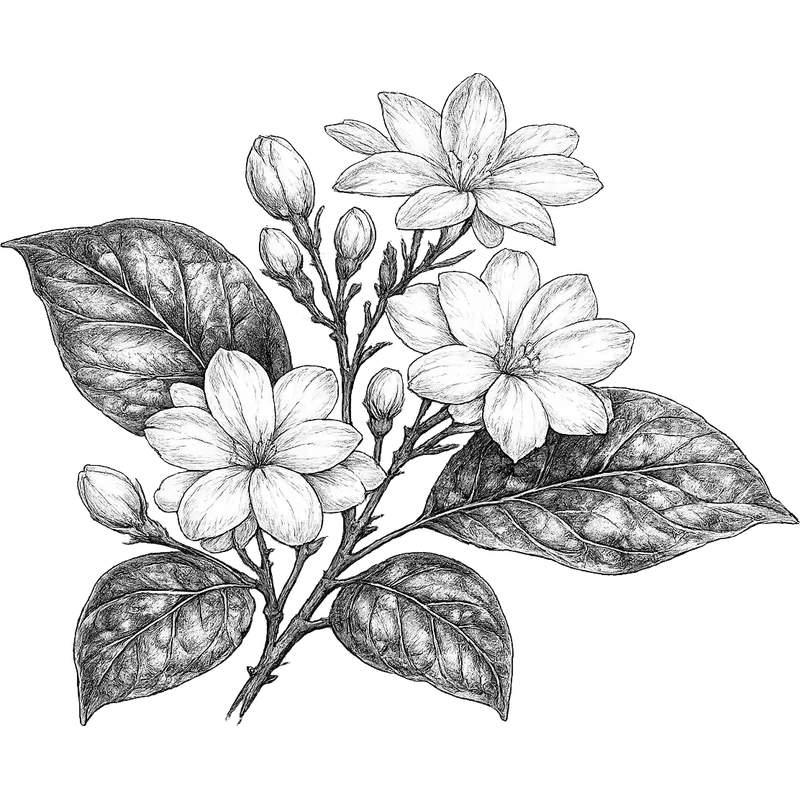
Jasmine is never distilled, because the flowers fall apart in steam. A solvent washes the scent out instead, which is why you buy an absolute rather than an essential oil. Benzyl acetate carries the sweetness, and a trace of indole adds the warm, faintly animal depth that makes jasmine smell alive rather than pretty. Pooling 44 randomised trials of essential oils for anxiety, jasmine came out near the top. Arabian jasmine gave the single largest drop in anxiety of any oil tested.[1]
Spanish Jasmine
Jasminum grandiflorum
- Also Known As
- Royal Jasmine, Grandiflorum Jasmine
- Family
- Floral
- Perfumery Note
- Base
- Intensity
- Very Strong
- Extraction
- Solvent Extraction
- Plant Parts
- Flowers
- Origins
- India, Egypt, Morocco
- Effect
- Romance & Mood, Energy & Uplifting
- Aroma
- Floral, Intoxicating, Sweet
- Applications
- Diffusing & Inhalation, Skincare, Perfumery & Fragrance Making
- Price
- $$$$Jasminum grandiflorum absolute requires dawn hand-picking of flowers that must be processed within hours; high-scale production in Grasse and Egypt provides more supply than Arabian jasmine, keeping it slightly more accessible
Spanish jasmine is the one perfumers mean when they say jasmine without qualifying it. A quarter to a third of the absolute is benzyl acetate, with indole in trace amounts doing the heavy lifting on character.[2] Carbon dioxide extraction concentrates the same set of compounds, including jasmone and methyl anthranilate, that give it that diffusive sweetness.[3] In tests on isolated gut muscle, the absolute relaxed contractions, working through a known cell-signalling route.[4] That is a tissue-bath finding, not a treatment, but it fits the traditional use as a relaxant.
Arabian Jasmine
Jasminum sambac
- Also Known As
- Sambac Jasmine, Pikake, Mogra, Belle of India
- Family
- Floral
- Perfumery Note
- Middle
- Intensity
- Strong
- Extraction
- Solvent Extraction
- Plant Parts
- Flowers
- Origins
- India, Philippines, China, Indonesia
- Effect
- Energy & Uplifting, Romance & Mood
- Aroma
- Sweet, Intensely Floral, Warm, Indolic, Rich
- Applications
- Diffusing & Inhalation, Skincare, Perfumery & Fragrance Making
- Price
- $$$$Jasminum sambac (sambac) absolute is produced mainly in India and Egypt in smaller volumes than grandiflorum; the more intensive harvest and limited commercial scale make it the more expensive of the two jasmine absolutes
Arabian jasmine is the heavier, more animal of the two, carrying more indole and methyl anthranilate. Its linalool roughly doubles at peak bloom, which is why picking time matters so much.[5] The flowers are strung into garlands for temples and weddings from India to the Philippines. In a pooled analysis of 44 randomised trials, it produced the largest drop in anxiety of any essential oil tested.[1] That is a strong result, though the individual trials behind it are small.
References
- [1]Essential oils for treating anxiety: a systematic review of randomized controlled trials and network meta-analysis - Tan L, Liao FF, Long LZ, et al. Frontiers in Public Health, 2023
- [2]Phytopharmacological Profile of Jasminum grandiflorum Linn. (Oleaceae) - Mittal A, Sardana S, Pandey A. Chinese Journal of Integrative Medicine, 2016
- [3]Liquid CO2 extraction of Jasminum grandiflorum and comparison with conventional processes - Prakash O, Sahoo D, Rout PK. Natural Products Communications, 2012
- [4]Jasmine absolute (Jasminum grandiflora L.) and its mode of action on guinea-pig ileum in vitro - Lis-Balchin M, Hart S, Lo BWH. Phytotherapy Research, 2002
- [5]An Efficient Extraction Method for Fragrant Volatiles from Jasminum sambac (L.) Ait - Ye Q, Jin X, Zhu X, et al. Journal of Oleo Science, 2015