 Essential Nose
Mandarin
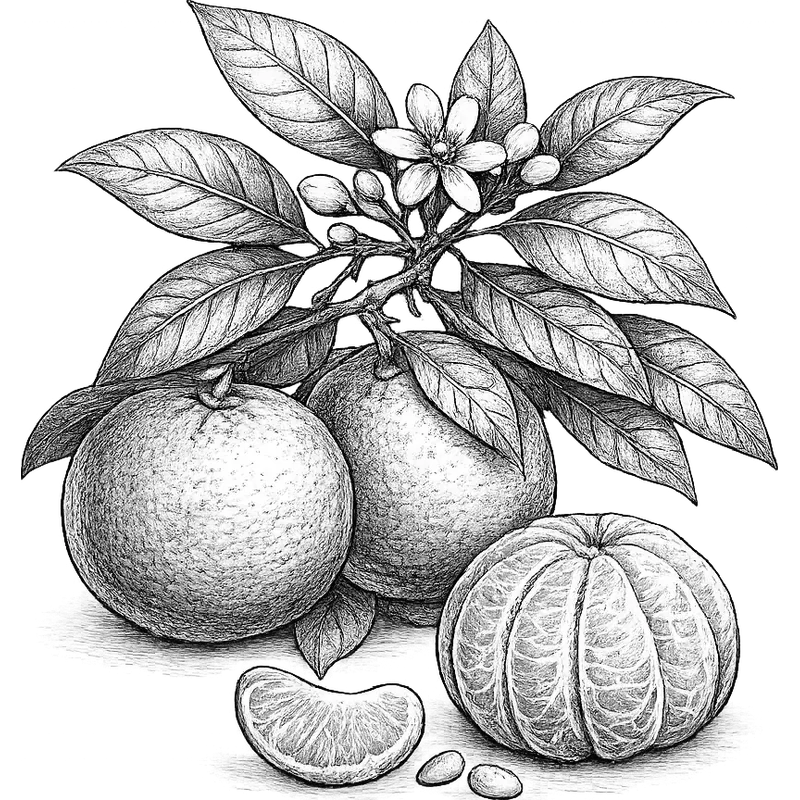
Mandarin is the gentlest of the citrus oils, sweet and soft where lemon is sharp. Around seven tenths is limonene, but what makes it smell of mandarin rather than orange is a trace ester with a fruity, faintly floral edge. The group covers fruit picked green, fruit picked ripe, and tangerine, which is a separate species. In lab tests the oil broke open Staphylococcus aureus cells and let their contents leak out.[1] In animal studies it eased anxious and low-mood behaviour, which fits its reputation as a calming oil.[2]
Mandarin
Citrus reticulata
- Also Known As
- Mandarin Orange, Tangerine
- Family
- Citrus
- Perfumery Note
- Top
- Intensity
- Light
- Extraction
- Cold Pressed
- Plant Parts
- Fruit peel
- Origins
- Italy, Brazil, Spain
- Effect
- Energy & Uplifting
- Aroma
- Citrus, Sweet, Delicate
- Applications
- Diffusing & Inhalation, Skincare, Perfumery & Fragrance Making, Cooking & Flavouring
- Price
- $$$$A specific harvest window between green and red; peel-pressed in large quantities
This is standard mandarin oil, cold-pressed from ripe peel. It is the citrus oil most often reached for with children and older people, because it is mild and easy to like. Limonene dominates, with methyl N-methylanthranilate giving the sweet, slightly floral lift that separates mandarin from orange. In lab tests it damaged Staphylococcus aureus cell membranes until the cells leaked.[1] In animal studies it reduced anxious and low-mood behaviour, which is the basis for its calming reputation.[2]
Tangerine
Citrus tangerina
- Also Known As
- Tangerine Orange
- Family
- Citrus
- Perfumery Note
- Top
- Intensity
- Medium
- Extraction
- Cold Pressed
- Plant Parts
- Fruit peel
- Origins
- United States, Brazil, Italy
- Effect
- Energy & Uplifting
- Aroma
- Citrus, Sweet, Fresh
- Applications
- Diffusing & Inhalation, Perfumery & Fragrance Making, Cooking & Flavouring
- Price
- $$$$Produced in massive quantities as a byproduct of the global citrus trade
Tangerine is a different species from mandarin, though the two are constantly confused on labels. Its peel oil is even more limonene-heavy, at around nine tenths, which makes it brighter and simpler than mandarin. The same trace ester found in mandarin gives it a fruity edge.[3] In lab tests it held back bacteria and mopped up the unstable molecules that damage cells.[3] Reviews of limonene itself credit it with calming inflammation.[4]
Mandarin Green
Citrus reticulata
- Also Known As
- Green Mandarin, Unripe Mandarin
- Family
- Citrus
- Perfumery Note
- Top
- Intensity
- Light
- Extraction
- Cold Pressed
- Plant Parts
- Fruit peel (unripe)
- Origins
- Italy, Spain, Brazil
- Effect
- Energy & Uplifting, Focus & Mental Clarity
- Aroma
- Citrus, Green, Sharp, Fresh
- Applications
- Diffusing & Inhalation, Skincare, Perfumery & Fragrance Making
- Price
- $$$$Picked before full ripeness in a narrower harvest window than standard mandarin, with slightly lower peel-oil yield per fruit
Mandarin green is pressed from fruit picked weeks early, while the skin is still green. The oil is only about half limonene at that stage, against seven tenths when ripe.[5] That leaves more room for the sharper compounds, so it smells bright, green and slightly bitter. Perfumers use it where ripe mandarin would be too sweet and round. It is the same species as mandarin red, just picked earlier, and a different species from tangerine.[5]
Mandarin Red
Citrus reticulata
- Also Known As
- Red Mandarin, Ripe Mandarin
- Family
- Citrus
- Perfumery Note
- Top
- Intensity
- Light
- Extraction
- Cold Pressed
- Plant Parts
- Fruit peel (ripe)
- Origins
- Italy, Spain, Brazil
- Effect
- Energy & Uplifting, Sleep & Relaxation
- Aroma
- Citrus, Sweet, Rich
- Applications
- Diffusing & Inhalation, Skincare, Perfumery & Fragrance Making
- Price
- $$$$Harvested at full ripeness in the widest, easiest harvest window with the highest peel-oil yield, keeping cost low
Mandarin red is pressed from fruit left on the tree until fully ripe. Ripening changes the oil: limonene climbs from about half at the green stage to around seven tenths when the skin turns red.[5] That extra limonene rounds the smell out, making it sweeter and less sharp than the green version. It is the mandarin to use where you want warmth rather than lift. The calming effects seen in animal studies were found for mandarin oil generally, not this harvest specifically.[2]
References
- [1]Antibacterial Effects and Mechanism of Mandarin (Citrus reticulata L.) Essential Oil against Staphylococcus aureus - Song X et al. Molecules, 2020
- [2]Antidepressant and anxiolytic potential of Citrus reticulata Blanco essential oil: a network pharmacology and animal model study - Nguyen NPK et al. Frontiers in Pharmacology, 2024
- [3]Chemical composition, antioxidant and antimicrobial activity of essential oils from tangerine, grapefruit, lemon and cinnamon - Denkova-Kostova R et al. Z Naturforsch C J Biosci, 2020
- [4]D-limonene: A multifunctional compound with potent therapeutic effects - Anandakumar P et al. Journal of Food Biochemistry, 2021
- [5]Changes of peel essential oil composition of four Tunisian citrus during fruit maturation - Bourgou S, Rahali FZ, Ourghemmi I, Tounsi MS. TheScientificWorldJournal, 2012