 Essential Nose
Myrtle
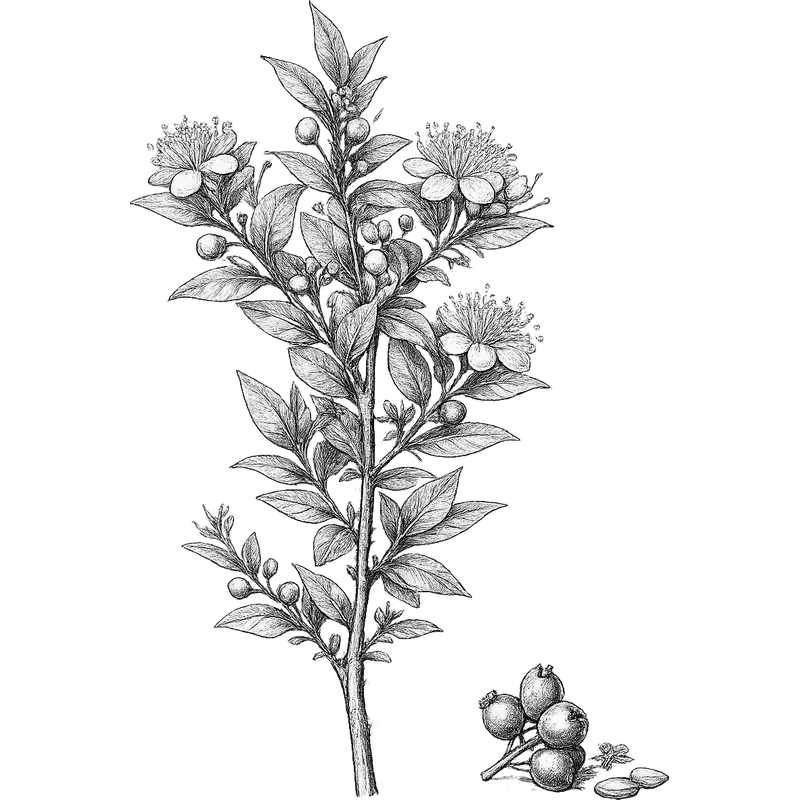
Myrtle has been a symbol of love and purity since classical Greece, and its oil comes in two forms that smell quite different. Green myrtle is built on 1,8-cineole and is clean and camphorous. Red myrtle swaps that for myrtenyl acetate and comes out soft, sweet and fruity. Both are the same species, and which you get depends on where in the Mediterranean it grew. In lab tests myrtle oil held back a wide range of bacteria, including drug-resistant strains.[1][2]
Green Myrtle
Myrtus communis
- Also Known As
- Myrtle, Common Myrtle, True Myrtle
- Family
- Herbal
- Perfumery Note
- Middle
- Intensity
- Medium
- Extraction
- Steam Distillation
- Plant Parts
- Leaves, Twigs
- Origins
- Morocco, Tunisia, Corsica, Sardinia, Spain, France
- Effect
- Respiratory Support, Romance & Mood
- Aroma
- Fresh, Herbal, Camphorous, Sweet
- Applications
- Diffusing & Inhalation, Skincare, Massage & Body, Perfumery & Fragrance Making
- Price
- $$$$Robust shrub grown at scale across North Africa and the Mediterranean; reliable leaf harvest and efficient steam distillation keep costs reasonable
Green myrtle is the cineole form, clean and camphorous with a sweet edge. Between a third and a half of the oil is 1,8-cineole, the compound that also carries eucalyptus. That is why it suits a blocked chest. Alpha-pinene and linalool round it off, keeping it softer than eucalyptus itself. In lab tests it held back a wide range of bacteria, including drug-resistant strains,[1] and inhibited the bugs behind mastitis in dairy cattle.[2]
Red Myrtle
Myrtus communis
- Also Known As
- Moroccan Myrtle, Myrtle CT Myrtenyl Acetate, Sweet Myrtle
- Family
- Herbal
- Perfumery Note
- Middle
- Intensity
- Light
- Extraction
- Steam Distillation
- Plant Parts
- Leaves, Twigs
- Origins
- Morocco, Albania, Croatia
- Effect
- Sleep & Relaxation
- Aroma
- Sweet, Fruity, Soft, Herbal
- Applications
- Diffusing & Inhalation, Skincare, Perfumery & Fragrance Making
- Price
- $$$$Sourced from specific Moroccan and Balkan myrtenyl-acetate-chemotype populations that are far less widely cultivated than standard Mediterranean cineole-chemotype myrtle stock.
Red myrtle is the same plant as green myrtle, grown somewhere else. It makes myrtenyl acetate instead of 1,8-cineole, so the camphor note is simply absent. What is left is soft, sweet and fruity, closer to a berry than a chest rub. The split runs geographically: Corsica, Sardinia and Tunisia give the cineole form, Morocco and the Balkans this one.[3] Screening Moroccan populations found it still holds back bacteria of both main types, despite losing the cineole.[4]
References
- [1]Chemical Characterization, Evaluation of Antimicrobial Potential, and Cytotoxic Activity of Thuja occidentalis L. and Myrtus communis L. Essential Oils for Topical Applications - Danila E, Marinas IC, Gaboreanu MD et al. Molecules, 2026
- [2]Mitigating Bovine Mastitis and Raw Milk Pathogen Risks: Inhibition of Staphylococcus xylosus by Mediterranean Plants' Essential Oil - De Fazio R, Di Giacinto G, Roncada P. Veterinary Sciences, 2025
- [3]Composition and chemical variability of Myrtus communis leaf oil from northwestern Algeria - Bekhechi C, Watheq Malti CE, Boussaid M, et al. Natural Product Communications, 2019
- [4]Intrapopulation variability of Myrtus communis L. growing in Morocco: chemometric investigation and antibacterial activity - Fadil M, Farah A, Ihssane B, et al. Journal of Applied Research on Medicinal and Aromatic Plants, 2017