 Essential Nose
Palmarosa
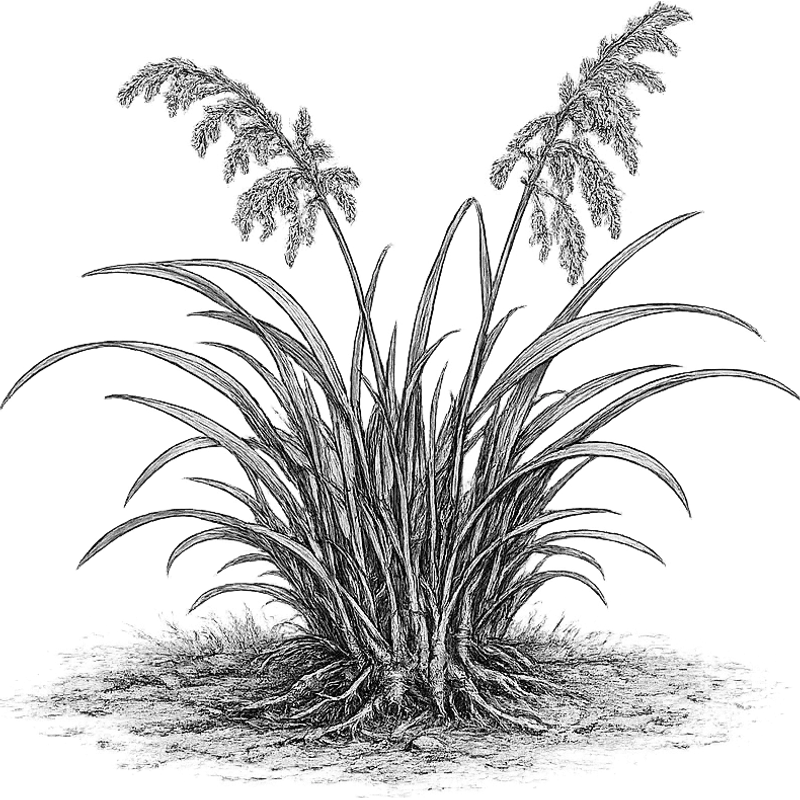
Palmarosa is a tropical grass that smells of roses, which is as odd as it sounds. The group also covers lemongrass and gingergrass, all Cymbopogon species, all smelling nothing like each other. What sets palmarosa apart is geraniol, at three quarters to nine tenths of the oil, one of the highest of any oil sold. At a tenth of a percent, palmarosa oil completely stopped brewer's yeast growing by wrecking its cell membrane.[1] It also held back Fusarium and Aspergillus moulds.[2]
Lemongrass
Cymbopogon citratus
- Also Known As
- West Indian Lemongrass
- Family
- Herbal
- Perfumery Note
- Top
- Intensity
- Strong
- Extraction
- Steam Distillation
- Plant Parts
- Leaves
- Origins
- India, Sri Lanka, Guatemala
- Effect
- Focus & Mental Clarity, Respiratory Support, Energy & Uplifting
- Aroma
- Citrus, Herbal, Sharp
- Applications
- Diffusing & Inhalation, Skincare, Massage & Body, Perfumery & Fragrance Making, Household & Cleaning
- Price
- $$$$A fast-growing tropical grass that can be harvested multiple times per year with a high yield
Lemongrass is the sharp one, more lemon than lemon itself. Two thirds to four fifths of the oil is citral, the compound that carries that smell. It is the best studied of the tropical grass oils. In lab tests it and citral held back fungi and bacteria, including the ones behind athlete's foot and food poisoning.[3][4] Citral is also a known skin sensitiser, so this is one to dilute properly.[5]
Rosha Grass
Cymbopogon martinii
- Also Known As
- Palmarosa, Indian Geranium
- Family
- Herbal
- Perfumery Note
- Middle
- Intensity
- Medium
- Extraction
- Steam Distillation
- Plant Parts
- Grass, Leaves
- Origins
- India, Nepal, Madagascar
- Effect
- Grounding & Centering, Energy & Uplifting
- Aroma
- Floral, Sweet, Rose-like
- Applications
- Diffusing & Inhalation, Skincare, Massage & Body, Haircare, Perfumery & Fragrance Making
- Price
- $$$$A fast-growing grass with a high yield, similar to lemongrass but with a rosy scent
Rosha grass is palmarosa under its Indian name, the same grass and the same oil. The name shows up on oils traded out of India, where most of the world's supply is grown and distilled. Like all palmarosa it is overwhelmingly geraniol, which is why it smells of roses rather than grass. At a tenth of a percent it stopped yeast growing outright by breaking its cell membrane.[1] It works against Fusarium and Aspergillus moulds too, which is part of why it turns up in skincare.[2]
Gingergrass
Cymbopogon martinii var. sofia
- Also Known As
- Sofia Grass, Rusa Grass
- Family
- Herbal
- Perfumery Note
- Top
- Intensity
- Medium
- Extraction
- Steam Distillation
- Plant Parts
- Leaves, Grass
- Origins
- India, Nepal
- Effect
- Grounding & Centering, Focus & Mental Clarity, Energy & Uplifting
- Aroma
- Fresh, Ginger-like, Lemony
- Applications
- Diffusing & Inhalation, Massage & Body, Perfumery & Fragrance Making
- Price
- $$$$A wild-growing grass in India; high oil content makes it an affordable "earthy" oil
Gingergrass is palmarosa's wild cousin, the same species growing untended. It makes perillyl alcohol and phellandrene instead of geraniol, so the rose disappears and something sharper and gingery takes its place. It is treated as the lower grade of the two, and priced accordingly. Whether that is fair depends on what you want, since the two smell almost nothing alike. Testing found the oil active against bacteria, with the balance of compounds shifting as the grass matures.[6]
References
- [1]Antimicrobial action of palmarosa oil (Cymbopogon martinii) on Saccharomyces cerevisiae - Prashar A et al. Phytochemistry, 2003
- [2]Essential oil of Cymbopogon martini, source of geraniol, as a potential antibacterial agent against Bacillus subtilis - Santamarta S et al. F1000Research, 2021
- [3]Anti-Candida albicans activity of essential oils including lemongrass (Cymbopogon citratus) oil and its component, citral - Abe S, Sato Y, Inoue S, et al. Nihon Ishinkin Gakkai Zasshi, 2003
- [4]Scientific basis for the therapeutic use of Cymbopogon citratus, stapf (Lemon grass) - Shah G, Shri R, Panchal V, et al. Journal of Advanced Pharmaceutical Technology and Research, 2011
- [5]Investigation of the dermal sensitization potential of various essential oils in the local lymph node assay - Lalko J, Api AM. Food and Chemical Toxicology, 2006
- [6]Influence of growth stage on the chemical composition, antimicrobial, and antioxidant potential of Cymbopogon martinii essential oil - Sonigra P, Meena M. Frontiers in Plant Science, 2025