 Essential Nose
Parsley
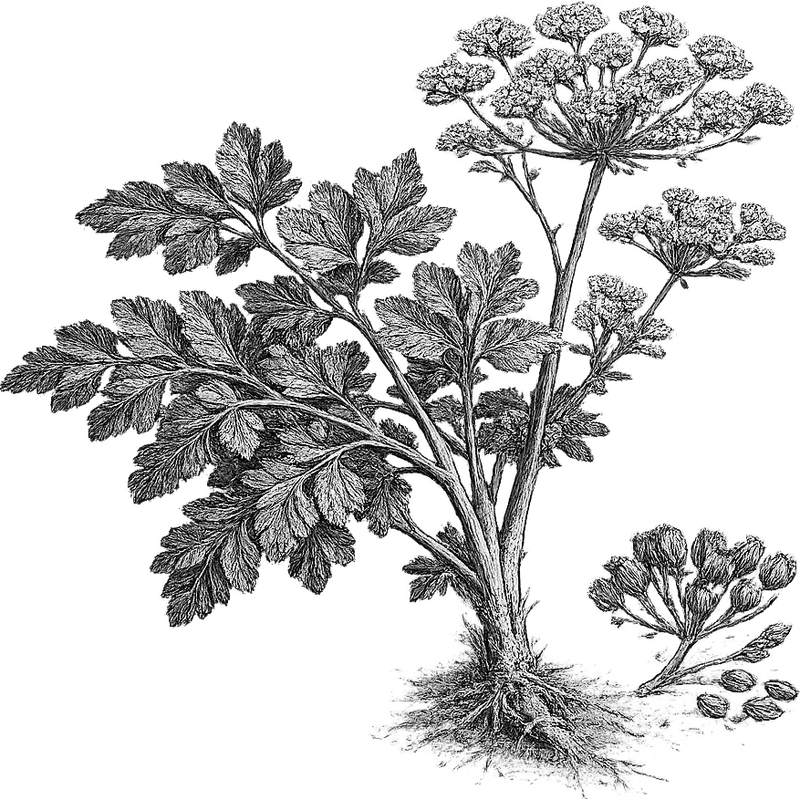
Parsley gives two oils that behave like different plants. Seed oil is heavy in apiol, a compound that acts on the womb and makes the oil unsafe in pregnancy. Leaf oil skips apiol almost entirely and is green, fresh and much gentler.[1] The gap is wide enough that the two carry different safety advice despite coming from one species.[1] In lab tests parsley oil held back bacteria of both main types and mopped up unstable molecules.[2]
Parsley Seed
Petroselinum sativum
- Also Known As
- Garden Parsley, Common Parsley
- Family
- Herbal
- Perfumery Note
- Middle
- Intensity
- Medium
- Extraction
- Steam Distillation
- Plant Parts
- Seeds
- Origins
- France, Netherlands, Hungary
- Effect
- Respiratory Support, Grounding & Centering
- Aroma
- Herbal, Warm, Spicy
- Applications
- Diffusing & Inhalation, Perfumery & Fragrance Making
- Price
- $$$$Higher yield than the leaf, but seeds are expensive to produce in bulk
Parsley seed oil is the dangerous one of the pair. Up to seven tenths of it is apiol, which contracts the womb and was once used to end pregnancies. That makes it an oil to avoid entirely in pregnancy, and to treat carefully at any time. Myristicin, the compound that makes nutmeg risky, is in there too. In lab tests it held back bacteria and fungi including Candida and Staphylococcus aureus.[3][4]
Parsley Leaf
Petroselinum crispum
- Also Known As
- Parsley, Garden Parsley, Rock Parsley
- Family
- Herbal
- Perfumery Note
- Middle
- Intensity
- Medium
- Extraction
- Steam Distillation
- Plant Parts
- Leaves
- Origins
- Netherlands, Germany, France, Hungary, India
- Effect
- Respiratory Support, Grounding & Centering
- Aroma
- Herbal, Fresh, Green, Slightly Spicy
- Applications
- Diffusing & Inhalation, Skincare, Massage & Body, Perfumery & Fragrance Making
- Price
- $$$$Parsley is a high-yield annual crop grown at large scale across Europe; abundant raw material supply and standard steam distillation keep costs low
Parsley leaf oil is the mild one, distilled from the fresh herb rather than the seed. It runs on phellandrene, which smells green and peppery, with only a trace of the apiol that makes seed oil risky. That is what makes it usable where seed oil is not. Blended with other culinary herb oils it held back Listeria and Staphylococcus aureus in dairy preservation tests.[5] Fed to broiler chickens it improved markers of cell protection and liver readings, which is an agricultural finding rather than a human one.[6]
References
- [1]Petroselinum crispum (Mill.) Fuss (Parsley): An Updated Review of the Traditional Uses, Phytochemistry, and Pharmacology - Bahramsoltani R, Ahmadian R, Daglia M et al. Journal of Agricultural and Food Chemistry, 2024
- [2]Petroselinum crispum L., essential oil as promising source of bioactive compounds, antioxidant, antimicrobial activities: In vitro and in silico predictions - Nouioura G, El Fadili M, El Hachlafi N et al. Heliyon, 2024
- [3]Antifungal and antibacterial activities of Petroselinum crispum essential oil - Linde GA et al. Genetics and Molecular Research, 2016
- [4]Parsley: a review of ethnopharmacology, phytochemistry and biological activities - Farzaei MH et al. Journal of Traditional Chinese Medicine, 2013
- [5]Optimizing Antibacterial Essential Oil Blends from Helichrysum plicatum, Petroselinum crispum, and Origanum vulgare for Dairy Preservation: Mixture Design and In Silico Analysis - Zivkovic J, Petrovic J, El Fadili M et al. Foods, 2026
- [6]Effect of parsley (Petroselinum crispum) oil as feed additive on broiler performance, carcass, liver and kidney functions, antioxidant, lipid profile, and immunity - Alagawany M, Elewa MS, Abou-Kassem DE et al. Animal Science Journal, 2024