 Essential Nose
Peru Balsam
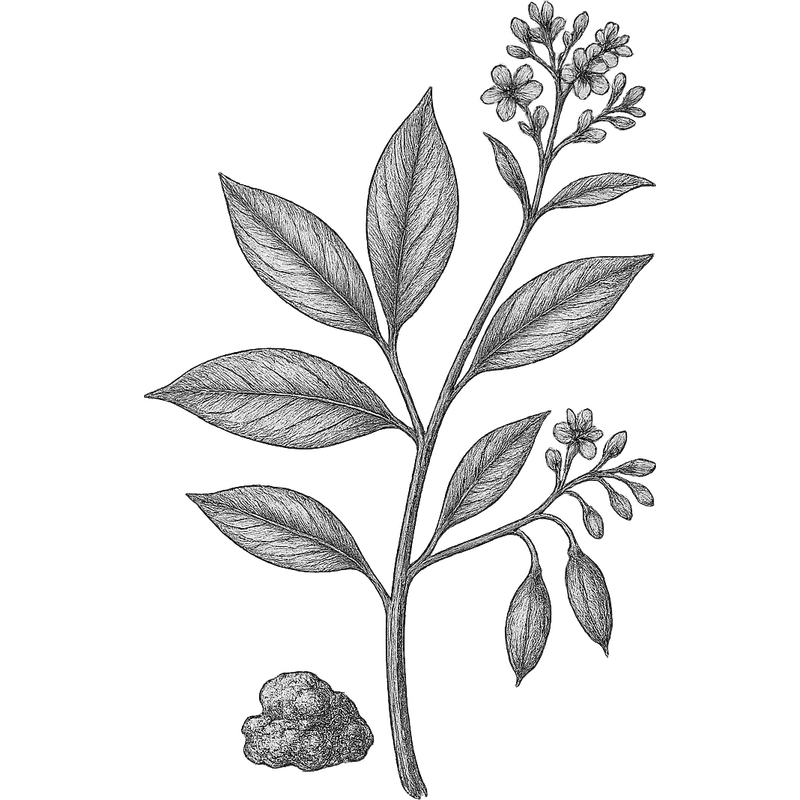
Peru balsam does not come from Peru but from a Central American tree, mostly in El Salvador. The resin is tapped by scorching and beating the bark, then boiling it out of the soaked cloths. It smells of vanilla and cinnamon, which is why it turned up in everything from cough syrup to perfume. Benzyl benzoate is about two thirds of it, with vanillin behind.[1] It is also one of the commonest contact allergens known, sensitising 4 to 8% of people patch-tested, and is now restricted in the EU.[2]
Balsam of Peru
Myroxylon balsamum var. pereirae
- Also Known As
- Peru Balsam, Peruvian Balsam
- Family
- Resinous
- Perfumery Note
- Base
- Intensity
- Strong
- Extraction
- Solvent Extraction
- Plant Parts
- Crude balsam, Resin
- Origins
- El Salvador, Honduras
- Effect
- Grounding & Centering
- Aroma
- Sweet, Vanilla-like, Cinnamon
- Applications
- Diffusing & Inhalation, Skincare, Perfumery & Fragrance Making
- Price
- $$$$Extracted through a traditional, manual process of 'wounding' wild trees and boiling the collected resin-soaked cloths.
This is the same material as Peru balsam, sold under its older name. It is a resin tapped from a Salvadoran tree, rich in benzyl benzoate at about two thirds.[1] Vanillin and cinnamic esters give the vanilla-cinnamon warmth that made it a fixture in perfumery and old wound dressings.[1] It is also a leading cause of allergic contact dermatitis, and dermatologists use it as a marker allergen in patch testing.[2] If you react to fragrance, this is one of the first things to suspect.[2]
Tolu Balsam
Myroxylon balsamum var. balsamum
- Also Known As
- Balsam of Tolu, Balsamo de Tolu, Myroxylon toluiferum
- Family
- Resinous
- Perfumery Note
- Base
- Intensity
- Strong
- Extraction
- Solvent Extraction
- Plant Parts
- Crude balsam, Resin
- Origins
- Colombia, Venezuela
- Effect
- Grounding & Centering, Respiratory Support
- Aroma
- Sweet, Balsamic, Vanilla-Cinnamon, Warm
- Applications
- Diffusing & Inhalation, Perfumery & Fragrance Making, Cooking & Flavouring
- Price
- $$$$Produced in smaller volumes than Peru balsam via traditional wild-tree tapping in Colombia and Venezuela, with far fewer commercial suppliers driving up cost.
Tolu balsam comes from the same tree species as Peru balsam, but a different variety and a different country. It is tapped in Colombia and Venezuela and left to air-dry into a firm resin rather than boiled out.[3] That gives it more free cinnamic acid, and a rounder, more vanilla-led warmth than the sharper Peru balsam.[3] The two share enough chemistry that anyone allergic to one should treat the other as risky. A recent case of contact dermatitis came from a Tolu-containing tincture used as a surgical dressing adhesive.[4]
References
- [1]Molecular profiling of Peru Balsam reveals active compounds - Gohringer A et al. Journal of Ethnopharmacology, 2020
- [2]Myroxylon pereirae resin (balsam of Peru): a critical review of the literature - de Groot AC. Contact Dermatitis, 2019
- [3]True and common balsams - Custodio DL, Veiga-Junior VF. Revista Brasileira de Farmacognosia, 2012
- [4]An unusual cause of allergic contact dermatitis in a postoperative patient - O'Mahony J, Goh Y, Lonergan A, et al. Contact Dermatitis, 2025