 Essential Nose
Pine
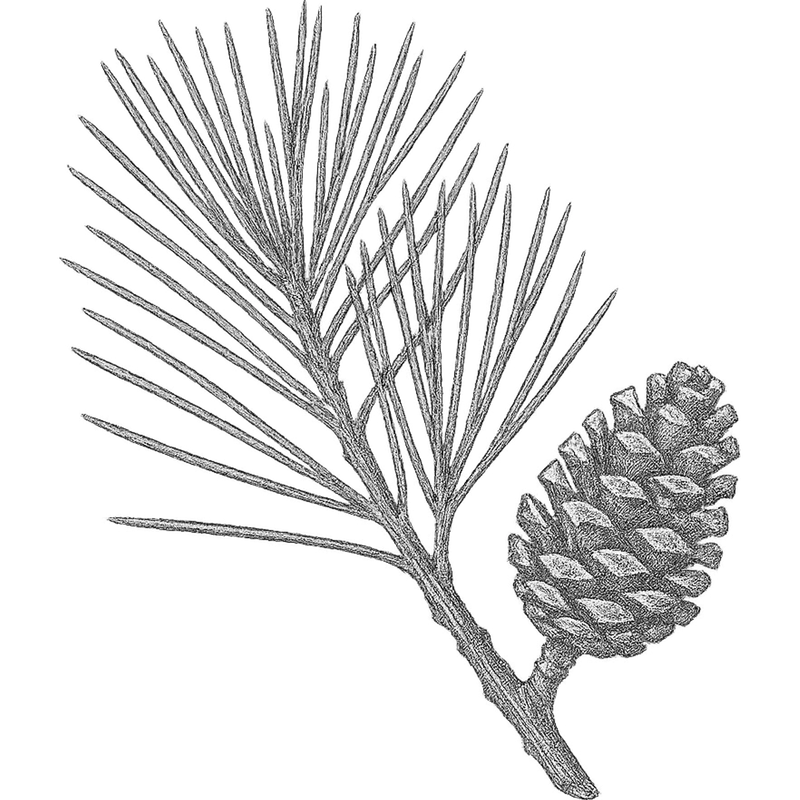
Pine oil is distilled from needles, which is why it smells green rather than sawn. Scotch pine is the standard, about two fifths alpha-pinene, sharp and resinous. The group also covers dwarf mountain pine, maritime pine and Swiss stone pine, each softer or sweeter in its own way. In mice, Scotch pine oil reduced airway over-reactivity brought on by bacterial toxin.[1] In lab tests it killed bacteria and broke up the films they build.[2]
Scotch Pine
Pinus sylvestris
- Also Known As
- Pine Needle, Scots Pine
- Family
- Woody
- Perfumery Note
- Middle
- Intensity
- Medium
- Extraction
- Steam Distillation
- Plant Parts
- Needles
- Origins
- Austria, Hungary, Russia
- Effect
- Focus & Mental Clarity, Respiratory Support, Energy & Uplifting
- Aroma
- Fresh, Coniferous, Resinous
- Applications
- Diffusing & Inhalation, Massage & Body, Household & Cleaning
- Price
- $$$$Abundant in North America with high oil content in the soft needles
This is the pine most people mean, distilled from Scots pine needles across northern Europe. Roughly two fifths is alpha-pinene, with bornyl acetate adding the balsamic edge that stops it smelling like a cleaning product. It is the sharpest and most resinous of the pines here. In mice, the oil reduced airway over-reactivity triggered by bacterial toxin, which is the clearest evidence behind its use for chesty breathing.[1] In lab tests it killed bacteria of both main types and disrupted their protective films.[2]
Pine Dwarf
Pinus mugo
- Also Known As
- Dwarf Mountain Pine, Mugo Pine
- Family
- Woody
- Perfumery Note
- Middle
- Intensity
- Medium
- Extraction
- Steam Distillation
- Plant Parts
- Needles
- Origins
- Poland, Austria, Switzerland
- Effect
- Respiratory Support, Grounding & Centering, Focus & Mental Clarity
- Aroma
- Fresh, Coniferous, Balsamic
- Applications
- Diffusing & Inhalation, Massage & Body
- Price
- $$$$Wild-harvested from remote high-altitude Alpine and Balkan slopes; modest yield keeps supply tighter than lowland pine species
Dwarf mountain pine grows low and twisted across the Alps and Balkans, above where taller pines manage. Its oil is sweeter and more balsamic than Scotch pine, with less alpha-pinene and more bornyl acetate. That makes it the easier one to live with in a room. In lab tests the oil slowed the oxidation of fats, working better in oily systems than watery ones.[3] Its terpinolene fraction did that alongside vitamin E and beta-carotene.[3]
Pine Maritime
Pinus pinaster
- Also Known As
- Maritime Pine, Cluster Pine
- Family
- Woody
- Perfumery Note
- Middle
- Intensity
- Medium
- Extraction
- Steam Distillation
- Plant Parts
- Needles
- Origins
- France, Portugal, Spain
- Effect
- Respiratory Support, Energy & Uplifting, Focus & Mental Clarity
- Aroma
- Fresh, Coniferous, Resinous
- Applications
- Diffusing & Inhalation, Massage & Body
- Price
- $$$$Large-scale plantations across the Landes forest and Iberian coast keep supply steady, though needle-specific distillation is less common than bark or resin extraction
Maritime pine covers the Landes forest of southwest France, planted to hold the dunes. The needle oil is greener and more peppery than Scotch pine, with caryophyllene and germacrene alongside the pinene. The species is better known for its bark extract, sold as Pycnogenol, which is a different product entirely. In experimental models the cone oil protected cells, calmed swelling and helped wounds close.[4] That is the cone oil rather than the needle oil sold here, so it is a lead rather than a claim.[4]
Pine Swiss
Pinus cembra
- Also Known As
- Swiss Pine, Arolla Pine, Swiss Stone Pine
- Family
- Woody
- Perfumery Note
- Middle
- Intensity
- Medium
- Extraction
- Steam Distillation
- Plant Parts
- Needles
- Origins
- Switzerland, Austria, Italy
- Effect
- Sleep & Relaxation, Grounding & Centering, Respiratory Support
- Aroma
- Fresh, Coniferous, Sweet
- Applications
- Diffusing & Inhalation, Massage & Body
- Price
- $$$$Slow-growing, protected high-altitude species with low needle-oil yield, making it one of the rarer pine oils on the market
Swiss stone pine grows slowly at high altitude, and Alpine tradition holds that sleeping near the wood helps you rest. The needle oil is soft and sweet, gentler than any of the lowland pines. Alpha-pinene leads at up to two fifths, with beta-phellandrene adding a fresh, almost citrus lift. A comparison of four conifer oils confirmed that composition and found it active against bacteria in both liquid and vapour form.[5] The sleep reputation is folklore rather than trial evidence.
References
- [1]Pinus sylvestris and Syzygium aromaticum Essential Oils Inhibit Endotoxin-Induced Airway Hyperreactivity in Mice - Csikos E et al. Molecules, 2022
- [2]Essential oils of Pinus sylvestris, Citrus limon and Origanum vulgare exhibit high bactericidal and anti-biofilm activities - Mosca A et al. Frontiers in Microbiology, 2023
- [3]Antioxidative properties of the essential oil from Pinus mugo - Grassmann J, Hippeli S, Vollmann R, Elstner EF. Journal of Agricultural and Food Chemistry, 2003
- [4]Research on the antioxidant, wound healing, and anti-inflammatory activities and the phytochemical composition of maritime pine (Pinus pinaster Ait) - Tumen I, Kupeli Akkol E, Tastan H, Suntar I, Kurtca M. Journal of Ethnopharmacology, 2018
- [5]Liquid and Vapor Phase of Four Conifer-Derived Essential Oils: Comparison of Chemical Compositions and Antimicrobial and Antioxidant Properties - Garzoli S, Laghezza Masci V, Caradonna V, Tiezzi A, Giacomello P, Ovidi E. Pharmaceuticals, 2021